Letters from Leura
JAMES JOYCE’S CAT
Wednesday July 1, 2015(c) Copyright 2018 John Stephenson
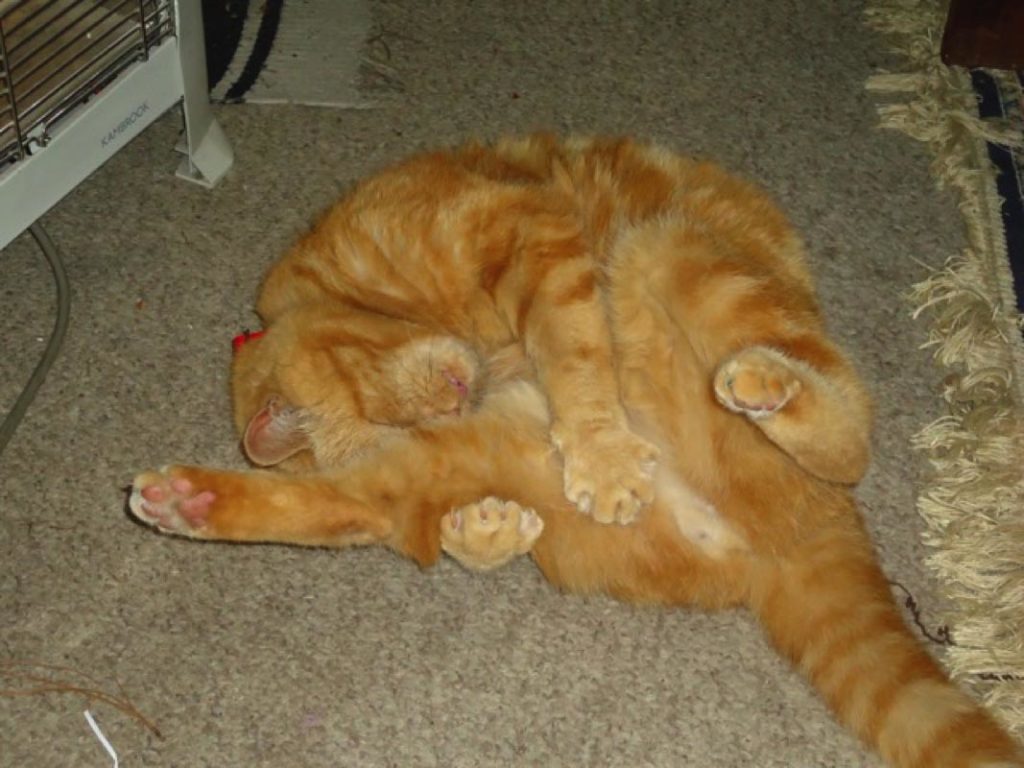
The brilliance of Joyce’s rendition of Leopold Bloom’s pet cat early in Ulysses: Mkgnao! Prr. Scratch my head. Prr.; with the increasing forcefulness as the milk appears: Mrkgnao!… Mrkrgnao!; struck me with great pleasure again recently. I’d been dropping in on the forsaken cat of some holidaying friends – looked after by street neighbours and visitors such as me – and also re-reading this greatest of novels in conjunction with an excellent set of audio lectures by a top Irish-American Joyce scholar. Hamish the old ginger tom, up against my ankle, was done justice to.
I’d also been taking my ancient green Bodley Head edition of Ulysses into my regular coffee shop, where its dilapidation removed any possibility of pretentiousness. Once, in a full Sydney bus, I watched a gent in an executive pinstripe settle into one of the two jump seats that face into the body of the vehicle, and at once open ostentatiously before the peak-hour multitude a new, loudly-labelled copy of the book with a ratty, upsniffing face that said: I don’t imagine you peons would even know how famous this book is.
Anyway, I became aware one morning this past week that I’d mislaid it. I checked everywhere else but, oh damn, almost certainly it was at the coffee shop. The senior waiter there, an amiable young woman from Cork in Ireland living on some land in North Katoomba, where with her partner she breeds pigs – when I asked her was it for a business she frowned back at me most askance: ‘No. For eating!’ – now recalled finding a left book that she assumed belonged to the café’s reading section.
– Did it have a cover falling off? she said.
– Yes!
– Oh gosh, I think I took it home with some other old books for repairs. And you know, I’ve always wanted to read Ulysses myself, such a famous book.
I was so overjoyed the thing hadn’t been lost that I, there and then, promised to present her with her very own copy of it.
– But what if it turns out I don’t have it? she said.
– I’ll need a new copy anyway!
So I began a search of local bookshops, new and second-hand, and had soon collected a nice vintage 1946 Random House edition from America – very small print – and a new giant version made half as big again as the original by added-on scholar’s footnotes. It then struck me that probably neither of these would be suitable for a first-time reader like my codex-saviour from Cork. Therefore I ordered for her a brand new paperback from Oxford University Press, accessible and with a modern photo-cover.
She was due back for work in the café on Saturday, so on Friday at home, there beside my fast-extending shelf of Joyces, I was looking forward very much to meeting her.
A phone call came through from my friends who owned the ginger cat and had finally got home.
– John, we want to thank you for enhancing Hamish’s education!
– Huh?
– We found him lazing in the sun beside an opened old Bodley Head copy of Ulysses. He liked so much being read to!
NATURE IN THESE PARTS (Ctd)
Sunday February 1, 2015(c) Copyright 2018 John Stephenson
This morning I read elsewhere in Virgil’s Aeneid – obviously I can’t keep away from it – Aeneas’ story of coming to that country to which his fellow Trojan Polydorus had earlier journeyed during Troy’s siege, in order to place in care of the King of Thrace a store of gold. Aeneas found, near where he was preparing a sacrifice to the Deities, a mound of earth with thickets of cornel and a cluster of myrtle-stems crowning it. Attempting to wrench some of this green growth out to make a leafy altar-covering, Aeneas to his horror saw dark blood oozing from the broken roots. Praying to avert this omen’s power, he tried again, and now heard a piteous human voice which revealed itself as that of Polydorus. He had been murdered and buried here by the avaricious and savage King to whom he had come in good faith. He begged Aeneas to cease rending his transformed corpse further.
My first, careless thought was that this does take some shine off Dante Alighieri’s originality. Something I’ve never forgotten from the Inferno in his C14th Commedia is the Wood of the Suicides. The shades of the poor self-slayers have been turned into bare trees, and when Dante breaks off a twig it bleeds and he hears the sufferer speak from the tree. Dante as poet indeed owes a great deal to Virgil as poet, gaining from him the essential notion of journeying to the Underworld and speaking to the dead, though Virgil himself gained it from the far more ancient Homer. Yet, though the notion of Homer and Virgil chiding Dante in Hell for stealing their ideas has another kind of comedy to it, in fact Dante’s world was one where learning was a living stream in which all shared. Almost certainly he was alluding, displaying his classical knowledge.
But the coincidence! My old friend the painter David Wilson, who died seventeen years ago and far too young, came up last week in a conversation I was having with a former student of his, out in the central west of the state. It was a sentimental conversation and I diverted from my route back home to the little bush cemetery where David is buried, near Rockley. Only once, long ago, had I revisited it after the interment.
Land sakes, but I couldn’t find him. Before a watchful magpie family I checked every plaque and headstone across those couple of acres of dry but well-tended grass, amid scattered shadeless box eucalypts in a hot sun, but nothing identified him. I left perplexed.
On the phone to another friend, I learned the remarkable truth.
Dear David has become a tree.
There is a metal-spoke enclosure around him, though with no identification, and in fact I had stood right beside it. But the space within is almost entirely occupied by a large and spreading shrubby tree, shady and green. As with Rupert Brooke, there is in that rich earth a richer dust concealed.
David, the best and kindest of men, has no affinity with Polydorus or Dante’s Wood. Yet I’m sure I’d now have a primitive inhibition, when next I visit, about breaking off any of his twigs.
NATURE IN THESE PARTS
Monday September 1, 2014(c) Copyright 2018 John Stephenson
The once-famous old movie comic, W.C. Fields, part of whose act was tippling, used to say that he liked to keep a stimulant handy in case he met a snake. He added he also liked to keep a snake handy.
Yesterday afternoon I was out walking on a sandy track in the bush near my hometown in the Blue Mountains of Australia. The ground here is strewn with dark twigs and branchlets of various sizes and its dust has a pink tinge. I easily could have been looking upwards for birds, but happened to look down… and realised that a particularly long bit of wood in front of me was a snake. Not moving. I was only a couple of steps from it at most, and would have walked right on top of it if I hadn’t looked down. It was getting toward one and a half metres long, with a low-contrast banding on it. It didn’t react to me, and I went absolutely still. Then I made very quiet, gentle backwards steps to end up I suppose five or so metres away. Then the snake’s head darted a bit, and slowly it turned around and slid off into long grass beside the track.
It had a strange beauty. The banding of smoky light brown and then smoky reddish bluish was subtle. When you sight a creature like this, it’s almost as if you intuit the origins of the Indigenous art palette. I made mental notes on its appearance and have now looked it up.
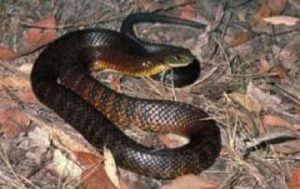
It was an adult Tiger, the fourth-deadliest snake in the entire world. One of its noted characteristics, it turns out, is that it doesn’t react to humans approaching it until they’re within a metre. Then you’re dead.
The picture here corresponds the closest in coloration to the one I met, a perfect adaptation to its surroundings.
When I told friends, they responded not just with Oh-No’s but with a flood of poems. Who said that literature was no longer relevant to life? They cited Emily Dickinson’s A Narrow Fellow In The Grass, D.H. Lawrence’s Snake, Judith Wright’s The Killer.
But the most apt and memorable was something from the second book of the great Latin poet Virgil’s Aeneid, dealing with the Trojan war. The Greek warrior Androgeos meets a band of Trojan warriors disguised in Greek armour. Thinking he’s with allies, Androgeos calls to them, then suddenly realises he has come upon the enemy. Virgil’s terrifying word-image here, beginning obstipuit retroque pedem cum voce repressit, is translated by the esteemed Latinist who sent it to me:
Androgeos is stunned. His footstep and his voice are paralysed,
just as one who, amid the rough undergrowth,
suddenly treads upon a snake lying on the ground.
Frightened and struggling to get away, he flees from
the creature, all swollen and rearing up
its grey-blue neck and its wrath. Not otherwise
did Androgeos, terrified by the sight, run away.
For myself, if I’d known that this attractive serpent in front of me was a tiger, my initial gentle backwards steps would have fast got me the whole two kilometres to the local railway station, in full Androgean style.